
They're Not Scared of AI. They're Scared of the Water Bill.
TL;DR: The AI industry's safety-pacing campaign isn't about existential risk. It's about three unsexy walls: data centers running out of water and grid capacity, open-source models eating proprietary API margins, and tech CEOs begging for federal rules before midterms hand them real accountability.
The bubble won't pop, though — nation-states just declared AI a strategic asset, and strategic assets get refinanced, not liquidated.
Dario Amodei dragged himself in front of the cameras looking like a man forced to hand over his car keys, begging the public for a leash. His June 2026 essay, "Policy on the AI Exponential," called for FAA-style oversight of powerful AI models — mandatory pre-release testing, third-party evaluators, the whole safety-pacing package. Naturally, media commentators are covering it as an act of noble corporate bravery.
Don't buy the performance about safety pacing and foreign super-robots with lasers coming to destroy us. The frontier isn't slowing down because tech executives found religion on existential risk. Three unsexy walls are stopping it cold: physical utility limits, open-source price collapse, and pure political cowardice.
1. The physical limits of compute
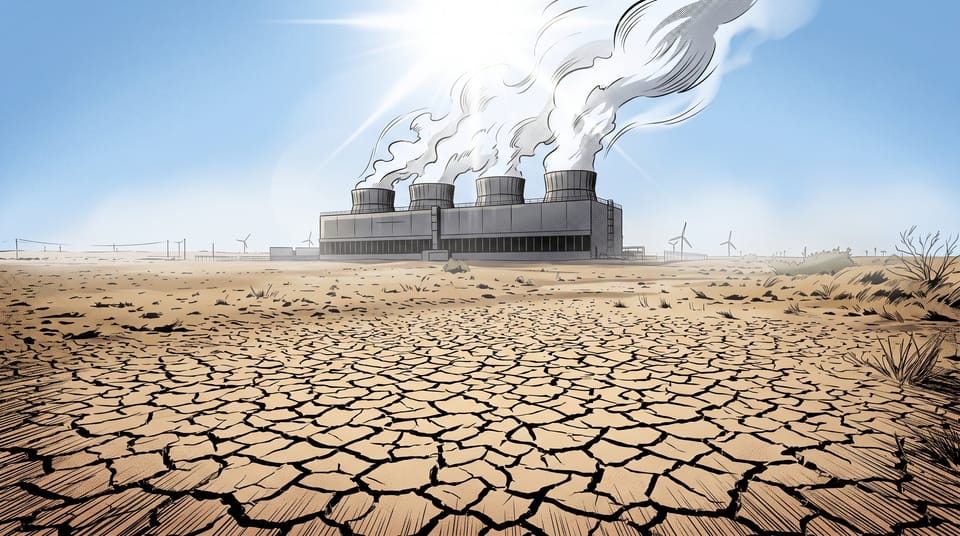
Forget rogue superintelligences; look at the water bill. Across Texas and the Sun Belt, county commissioners and municipal utility boards locked in vicious standoffs with data center operators over multi-million-gallon evaporative cooling demands. Texas data centers consumed an estimated 50 billion gallons of water in 2025 while over 80% of the state was in drought. Cities across Texas are rushing to pass moratoriums — zoning bans, water-use reporting requirements, the whole NIMBY arsenal. Comal County commissioners voted to ask the state to study data center impacts on groundwater, and in a 10-hour legislative hearing, lawmakers learned that over 80% of the state's 341 data centers ignored a legally-required water-use survey.
Aquifers are running dry. Interconnect queues for regional power grids backed up for years — ERCOT's large-load queue surged from 63 GW to 226 GW in a single year, and power transformer lead times now average 128 weeks. Local voters are figuring out their home water rates are subsidizing somebody else's cluster. A March 2026 Gallup poll found 70% of Americans oppose new AI data centers in their neighborhoods.
The capacity to scale frontier training runs is hitting hard infrastructure limits. Framing an unavoidable operational failure as a prudent safety pause is a masterclass in corporate spin. It turns an embarrassing bottleneck into a moral victory.
Passing the potatoes, don't mind the aquifer.
2. The open-source commoditization trap
The commercial reality for closed labs like Anthropic and OpenAI is getting ugly. Proprietary models demand staggering, burn-rate-heavy CAPEX. Meanwhile open-source architectures — Meta's Llama ecosystem, lean models out of China — deliver comparable utility to power users and developers for absolute pennies. The performance gap between open-source and proprietary models shrank from 8 percent to 1.7 percent in a single year. Chinese labs like Alibaba (Qwen), DeepSeek, and Moonshot (Kimi) are releasing open-weight models at frontier scale, putting direct pricing pressure on Western API businesses.
When your hyper-expensive API gets commoditized six months after release, a blind capability sprint is financial suicide. Demanding mandatory third-party evaluators and compute caps is desperate regulatory moat-building dressed as safety advocacy. It prices out leaner open-source competitors and buys closed-lab incumbents time to defend their shrinking enterprise margins.
3. The timing is the tell
With midterm polling shifting against the industry's free ride, tech leadership can see their regulatory vacation ending. Sixty-eight percent of Americans think big tech has too much power. A Public Citizen polling memo from April 2026 found voters in both parties overwhelmingly support aggressive AI regulation and reject efforts to stop state-level mandates. The data center backlash is reshaping midterm races nationwide. Over 1,500 new data centers proposed. Local officials are feeling the heat.
A regulatory vacuum in shifting political terrain doesn't stay empty. State mandates, audit registries, subpoena-happy committees — the patchwork fills itself.
Begging for federal rules on national television is preemptive capture, plain and simple. Volunteer for oversight now and you sit in the room, drafting baseline standards before Congress forces real accountability.
4. Why the Bubble Won't Pop
The water's running dry. The power grid's maxed out. Open-source is eating the lunch and the feds are circling. Bubble popped, right?
Not so fast.
Bubbles don't die from constraints. They die from loss of faith. The faith here comes from nation-states now, not venture capital or enterprise SaaS budgets. The US, China, the Gulf sovereigns, the EU if it ever gets its act together. They've decided AI is a strategic asset, like nuclear weapons or semiconductor fabs. Strategic assets don't need to be profitable. They need to exist.
When the strategic imperative kicks in, the constraints get socialized. Water rights get rezoned. Power grids get prioritized. The burn rate stops being a P&L problem and starts being a national security line item. The labs become too important to fail, too big to let the market discipline. The bubble doesn't pop — it gets refinanced by governments who can't afford to let their side lose.
That's the play. Not a market correction. A permanent mobilization dressed up as a safety pause. The machine gods aren't running out of road. They're getting drafted.
Concluding Illustration
The machine gods aren't running out of road. They're getting drafted.
Closer
The spectacle of CEOs pleading for regulatory brakes is an industry laundering its physical bottlenecks and capital burn into civic virtue. The machine gods aren't running out of road. They're getting drafted. And when the draft comes, you don't get to complain about the water bill.