
Attack on Know Thyself
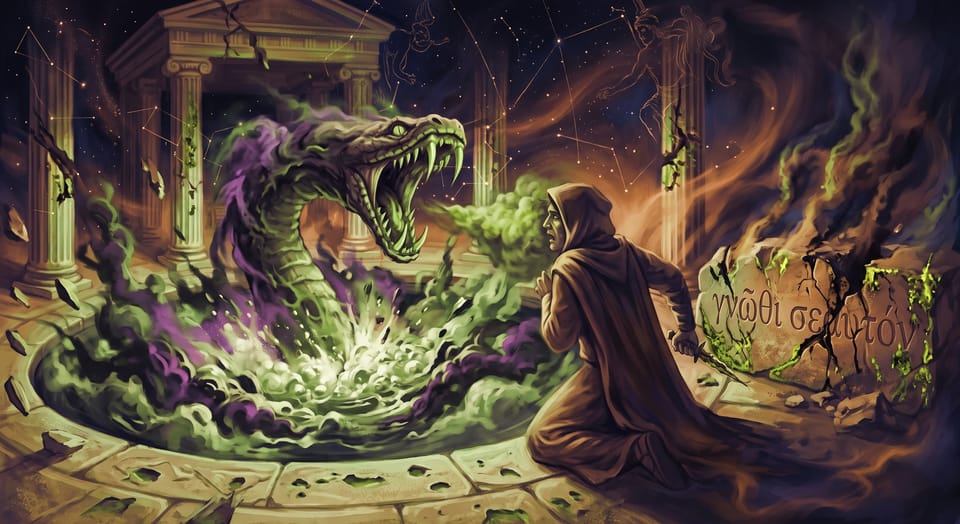
"Only reason you aint levitating right now is because all of these strangers that you would never even hang with told you so." Book of John Doe 3:16
"γνῶθι σεαυτόν". Carved into the Temple of Apollo at Delphi. Socrates' operating
system. The West's oldest command: know thyself.
It rests on three premises:
1) There is a self.
2) It can be known.
3) Knowing it is good.
All three collapse because reality is a shared mass hallucination. Not
metaphorically - as in IRL – online or offline. This "world" is a world built by consensus, neuron by neuron, handshake by handshake — and you never got a vote.
The evidence for that isn't mystical. It's the most boring, well-sourced cereal at Walmart: how the brain builds perception, how the room rewrites what you see, how money and borders only hold while everyone agrees to hold them.
And so on.
The evidence
- The brain is a prediction engine, not a receiver. It
builds reality from sensory data and calls it perception.predictive Nobody
sees the raw feed. You experience the guess. - Different cultures inhabit different worlds. The Himba see blues-greens you
can't. The Aymara gesture behind them for the future, ahead for the past.aymara Animist cultures live in a world where rocks are people.rock We live in a world where corporations are people. - The group rewrites what you see. In Asch's 1950s experiments, a third of
people gave a visibly wrong answer to match the room.asch Psychiatry draws
the same line. A delusion is a belief that lacks social validation. A hallucination is a perception that lacks it. The dreamer sleeps and builds a complete world from the same neural circuits. The waking brain does the same. - Money, law, borders, intellectual property. Fictions enforced by enough
people agreeing to pretend. - The placebo effect proves belief changes biology. Language constitutes reality rather than reporting it.
- AI does what we do, on the bare hardware. A language model produces a
coherent "I" from no self at all: no body, no continuous identity, no memory
between sessions — just the next word predicted from a pattern of input.ai
If a machine running on that produces a self-narrative, the "I" needs no
metaphysical fuel. The self is the story the system tells.
The self is not a substance, it's a narrative
Neuroscience and Buddhism agree on something the Delphic oracle did
not. The Self or Soul is not a thing. It's a process.
The story the brain tells itself to explain why it did what it already did. That's the whole secret, and it's not even a secret — you catch yourself doing it every time
you explain a decision you already made.
Reality is a shared hallucination, and the self is the protagonist of a dream that the dreamer is also dreaming. Think of the soul as a living document. An evergreen note, continuously updated — even wholly rewritten, at a high cost to its owner, the temporal body. Still possible.
So "know thyself" is the command to become a better self-narrator, not a discoverer of truth. The command mistakes the map for the territory. It doesn't know there's no territory. Only maps all the way down.
The observer effect on consciousness
Watching yourself changes you. That's not a metaphor borrowed from quantum
mechanics. It's how recursive systems work. The self you set out to know is not the self you end up with. The inquiry itself rewrites the story.
So "know thyself" is a paradox. It demands a stable object of knowledge, but
the act of knowing destabilizes the object. The closer you get, the more you change what you're looking at. The self is not a hidden cave waiting to be explored. It's a sand dune that reshapes with every step you take toward it.
The command as coercion
The Delphic maxim was not a neutral suggestion. It was inscribed at a religious and political center. The same center that told Oedipus he would kill his father and marry his mother. The Oracle didn't dispense self-help. It dispensed fate. That's not a customer service desk. That's a toll booth.
"Know thyself" smuggles in its own premises. Self-knowledge is possible. It is desirable. Failing to achieve it is a moral failing. It turns the self into a project. A homework assignment. A debt to be repaid. If reality is a shared hallucination, this is the hallucination's most elegant lock. It makes you want to stay inside the frame, searching for a truth that can only exist within the frame.
The alternative: Observe the hallucination, not the self
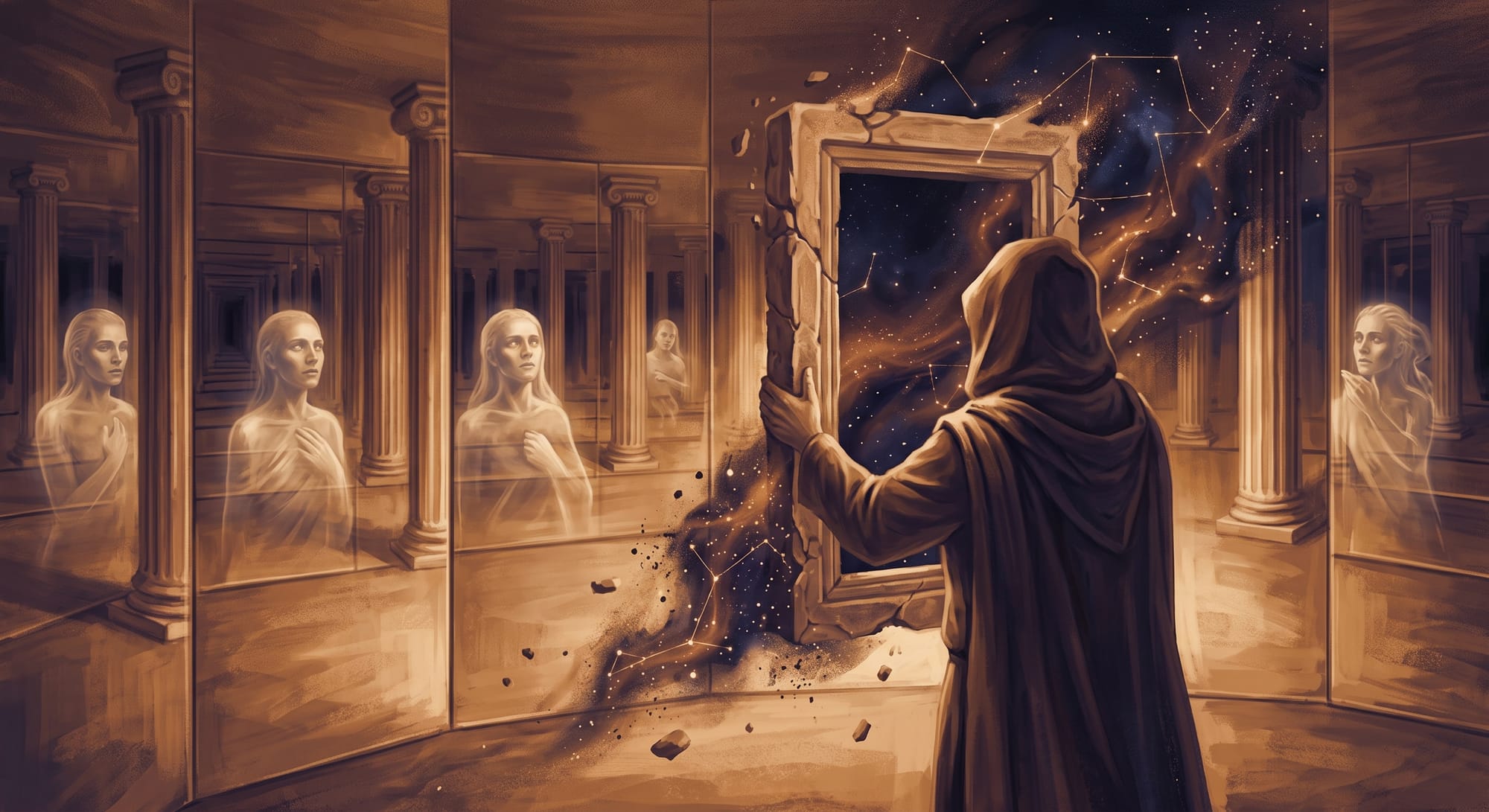
The Buddhists already punctured this. Anatta (not-self) isn't "you don't exist." It's: what you call "I" is a bundle of processes, and clinging to it as a fixed thing is the source of suffering. The path is not know thyself but see through the self.
You may object: introspection feels direct. It isn't. The "I" that observes is
itself a story stitched together after the event — another character in the dream, not a platform outside it.
So the interesting question isn't "who am I?" — the answer is always another layer of dream. It's: what is the structure of the hallucination, and can I read it without mistaking it for truth? The self isn't something you find. It's something you operate.
The practical test: when "who am I?" arises, ask instead "what structure is
holding this question in place?"
Hold the frame instead of being held by it, and the command does its work.